
Writing
- Home E
- Curriculum E
- English E
- Writing E
Writing Curriculum Intent
At Smith’s Wood Primary Academy, we believe that every child is on a journey of learning to becoming a proficient, independent writer. They will develop an understanding of the purposes of writing and the ability to adapt their writing to meet the needs of different audiences.
We believe that children produce their best writing when they are well prepared, so our provision will include:
- Rigorous teaching of phonics and handwriting to ensure transcription becomes fluent.
- Reading and becoming familiar with good quality literature.
- Opportunities to develop spoken language including oral composition.
- Explicit teaching of ambitious vocabulary.
- Regular opportunities to undertake the writing process.
- Celebration and publication of final written pieces.
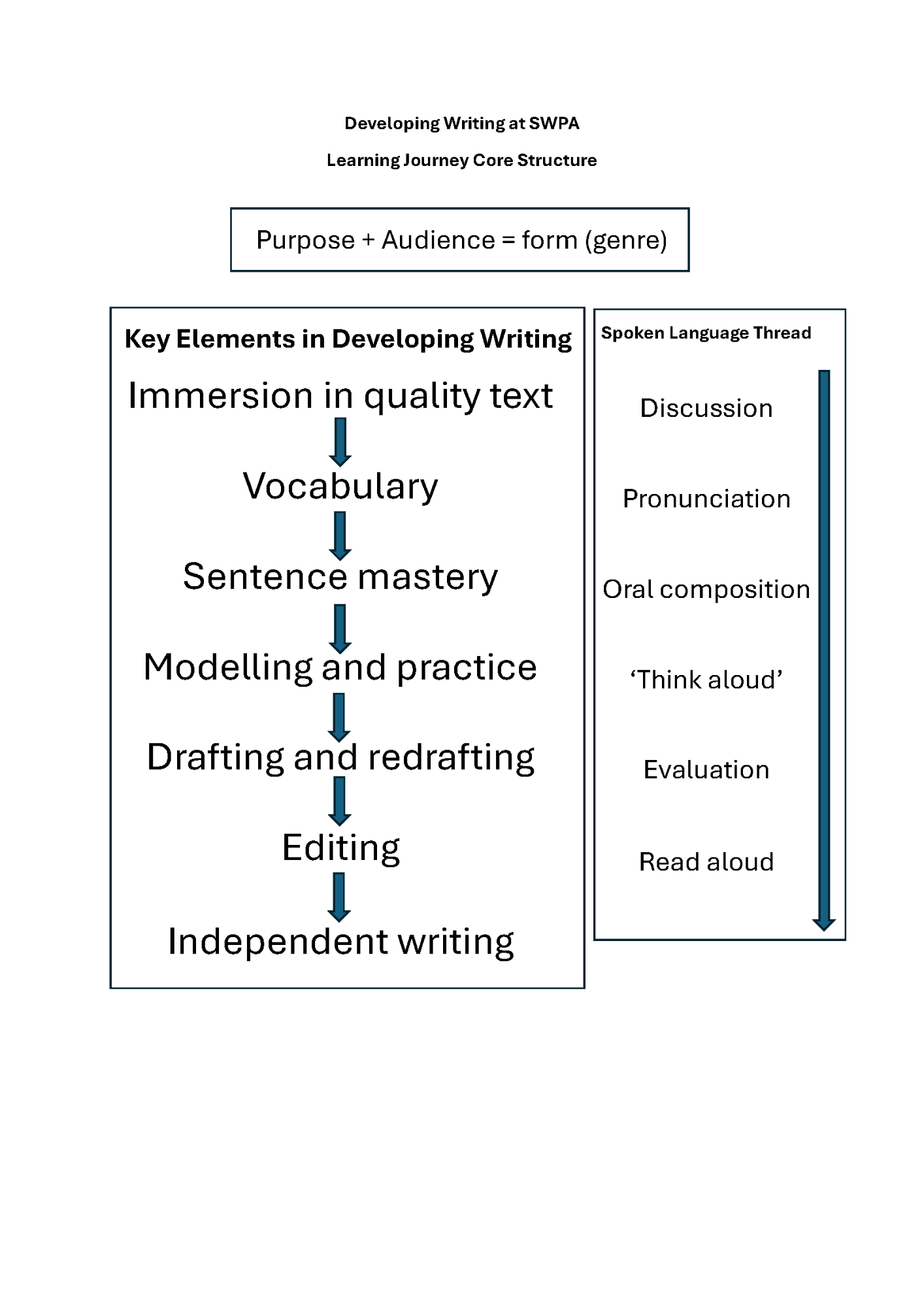
Implementation
Our Key Elements to developing quality writing:
Immersion in quality texts
- A hook to establish engagement, enjoyment & purpose.
- Immersion in the genre; reading quality texts.
- Spoken language opportunities such as role play, or hot-seating.
- Focus on relevant features, for example character or setting in fiction; or formality or genre features in non-fiction.
Vocabulary
- Explicit teaching will establish correct pronunciation, spelling and definitions of ambitious vocabulary.
- Regular practice will also improve reading fluency.
- Vocabulary will be displayed on working walls.
Sentence Mastery
- Use of the Ark Sentence Mastery document will ensure progression and continuity.
- Misconceptions are promptly addressed.
- Grammar objectives are taught within a context relating to the text being studied.
Modelling and Practice
- Teachers model the writing process, using ‘think-alouds’ to demonstrate the decision-making and thinking process that writers use.
- Children have regular opportunities to practise and apply their vocabulary and sentence learning.
- Model texts are used to illustrate what a good example looks like.
The Writing Process
- Children develop the ability to draft and redraft their writing, using pink polishing pens to edit their work for secretarial errors.
- Children develop the skill of redrafting, in order to make effective changes to their work with a reader in mind.
- Independent writing opportunities are planned at least twice each half term.
Learning environments
Content on classroom working walls will be current, reflecting the learning journey being undertaken throughout the teaching sequence. (Teaching should encourage children to be a part of building the working wall together and reminding children to use and access the learning from the working wall to support their writing).
Each class displays and celebrates children’s writing, from Literacy and from across the curriculum.
Handwriting letter families, together with writing posture visuals, are displayed and regularly referred to when reinforcing expectations.
Impact
By the time children leave Smith’s Wood Primary Academy they will:
- Make strong progress from their starting points, including KS1 outcomes, through a carefully sequenced and well-supported writing curriculum.
- Most children will meet Age-Related Expectations in writing by the end of KS2 and be well prepared for the demands of the secondary curriculum.
- Be confident, independent writers who can plan and draft their writing effectively
- Be able to evaluate and improve their own writing using taught strategies, including editing and redrafting for impact and accuracy.
- Have a genuine enjoyment of writing, writing for a range of purposes and audiences across both fiction and non-fiction contexts.
- Apply ambitious vocabulary, spelling patterns and grammatical structures accurately and appropriately in their independent writing.
- Communicate clearly and effectively, both orally and in writing, using a rich and increasingly sophisticated vocabulary.
- Produce high-quality written work across all curriculum areas, demonstrating the ability to apply writing skills in different subjects.
- Show pride in their writing, taking care to present work neatly, accurately and thoughtfully, reflecting high expectations for handwriting and transcription skills.
Assessment
Each half-term, one of the independent writing opportunities is an assessed piece of work, and we use the Local Authority TAF sheet at the front of the Literacy book to record our assessment judgements.
Moderation
Throughout the academic year, regular opportunities for writing moderation are built into the assessment cycle to ensure accuracy and consistency of our teacher judgements.
We attend standardisation training to develop and maintain a shared understanding of the writing assessment criteria, with further opportunities provided to apply and test this understanding in line with Local Authority expectations.
Assessed pieces of writing are moderated within year groups to ensure consistency, while whole-school moderation across year groups is scheduled twice a year during dedicated staff meeting time. In addition, we moderate writing across schools twice annually through Local Authority-led moderation sessions, enabling us to validate judgements, share best practice, and ensure assessments remain accurate, reliable, and consistent.
Monitoring
The impact and delivery of our writing curriculum are closely and consistently monitored to ensure high standards are maintained across the school. The writing curriculum and teaching sequence are regularly reviewed and refined in response to identified areas for improvement, ongoing assessment outcomes, and changes to assessment frameworks, resources and government expectations. This ensures that our teaching remains current, purposeful and effective.
Monitoring activities include book trawls, lesson-observation walks, pupil voice and moderation of writing, enabling leaders to evaluate the quality of provision and the progress pupils are making.
Where necessary, adaptations are made promptly to strengthen practice and ensure that all children continue to receive high-quality writing instruction that supports strong outcomes.